Medical Transport Services for Oxygen Patients
Table of Contents
Oxygen-Dependent Patient Transport: Who Qualifies and How It Works
Medical Transportation with Portable Oxygen: Equipment and Onboard Support
Wheelchair Transportation with Oxygen: Combining Mobility and Respiratory Needs
Long-Distance Non-Emergency Medical Transport: Planning for Longer Rides
How to Book Oxygen-Assisted Transport: Information to Have Ready
Last Updated: October 12, 2026
Medical Transport Services for Oxygen: What to Expect
[Medical transport](/services) services for oxygen are non-emergency rides staffed and equipped to move patients who rely on supplemental oxygen, with onboard oxygen, trained attendants, and vehicles built for wheelchairs and medical equipment.

Emergency vs. Non-Emergency: Knowing the Difference
Emergency transport is for life-threatening situations and is handled by 911 and paramedics. Non-emergency medical transport is for scheduled, stable trips: dialysis, follow-up visits, facility transfers, and discharges.
If a passenger is short of breath at rest, unresponsive, or in chest pain, call 911. The Medicare guidance on ambulance and non-emergency transport draws a similar line: emergency ambulance service is for immediate medical attention, while scheduled transport is for stable patients.
Knowing which one you need protects the passenger. It also keeps scheduled providers focused on the rides they are built to handle.
Oxygen-Dependent Patient Transport: Who Qualifies and How It Works
Oxygen-dependent patient transport fits passengers who use supplemental oxygen but are medically stable for a scheduled ride. That includes people on portable oxygen concentrators, those with small portable tanks, and patients whose oxygen needs are managed and predictable.
Qualification is not about a diagnosis. It is about stability. A provider will ask how much oxygen you use, whether you can transfer into a vehicle with help, and whether a caregiver or clinician has cleared you for ground transport.
Clinical Suitability and Equipment Checks
Before booking, confirm three things with the care team: the prescribed flow rate, whether portable oxygen is allowed for the trip length, and any mobility limits. A provider should verify that your oxygen equipment is in working order and that the vehicle can secure it safely.
What most guides miss is that "stable" is a clinical judgment, not a booking decision. If you are unsure whether a scheduled ride is appropriate, ask the treating clinician first.
Watch Out Booking a non-emergency ride for someone who is actively deteriorating can delay real emergency care. If symptoms are new or worsening, call 911 instead of scheduling transport.
Medical Transportation with Portable Oxygen: Equipment and Onboard Support
Medical transportation with portable oxygen depends on matching equipment to the trip. The vehicle should have a safe way to secure tanks or concentrators, and staff should know how to check that your device is running.
Onboard support usually means oxygen availability in the vehicle, a trained attendant, and the ability to respond if a passenger's breathing changes.
What to Bring and How to Prepare Your Oxygen Equipment
Preparation is where riders lose the most time. A short checklist keeps the trip smooth:
Confirm the prescribed flow rate and bring written instructions
Check that portable tanks or the concentrator are fully charged or filled
Bring backup batteries for a concentrator
Charge or refill everything the night before. A concentrator that dies mid-trip turns a routine ride into a problem.
Wheelchair Transportation with Oxygen: Combining Mobility and Respiratory Needs
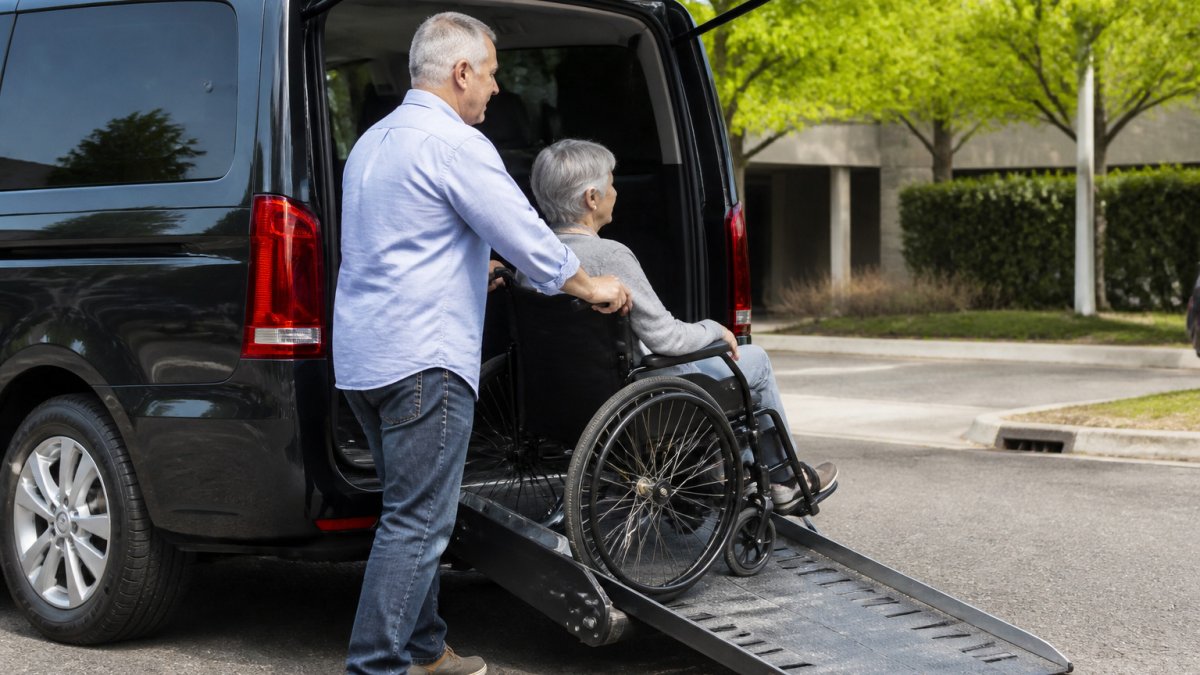
Wheelchair transportation with oxygen combines two needs that must be handled together. The vehicle needs a secure wheelchair tie-down and a safe place for oxygen equipment, so neither shifts during the ride.
Not every accessible van is set up for both. A provider that only handles basic wheelchairs may not have a safe way to secure a tank or concentrator.
Pro Tip Tell the provider your wheelchair's dimensions and your oxygen equipment type when you book, not when the van arrives. That single detail prevents most last-minute refusals and delays.
Long-Distance Non-Emergency Medical Transport: Planning for Longer Rides
Long-distance non-emergency medical transport needs more planning than a local trip. Longer rides mean more oxygen consumed, more battery drain, and more time between stops. Most provider pages stop at "we offer long-distance service" and never explain how to actually plan the oxygen side of a multi-hour ride. That planning is where trips fail.
Do the Oxygen Math Before You Book
Start with the prescribed flow rate and the expected time in the vehicle, not just the drive time. Add loading, waiting, the appointment itself if you stay on oxygen, and the return leg.
Continuous flow: multiply the prescribed liters per minute by 60 to get liters per hour, then by total hours in transit. A 2 L/min prescription consumes roughly 120 liters per hour.
Pulse-dose concentrators: output varies with breathing rate, so a concentrator rated for a given setting may deliver less at higher respiratory rates. Treat the manufacturer's rated battery life as a best case, not a guarantee.
Cylinders: a standard small portable cylinder holds far less than a full-size tank, and the duration depends on the flow setting. Check the cylinder's own duration chart rather than estimating.
Whatever the total, bring a margin, most practitioners suggest planning for at least 50 percent more oxygen and battery than the raw calculation, because traffic, a delayed appointment, or a longer discharge process all extend the ride.
Backup Power and Redundancy
For any ride long enough to drain a primary supply, carry a second source: a spare charged battery, a backup cylinder, or both. Confirm the vehicle has a way to secure and, where applicable, power or charge equipment during transit. Ask whether the provider carries onboard oxygen as a backup or expects you to be fully self-sufficient, the answer changes what you pack.
Stops, Monitoring, and Regional Transfers
Ask how the provider handles rest stops and whether staff can monitor your breathing over a longer stretch. For facility-to-facility transfers that cross regions, confirm the provider's service area covers both ends of the trip, or whether a handoff to another provider is required. A handoff adds coordination time and a second set of equipment checks.
Pro Tip Write the total round-trip time on paper, add your margin, and match it against your cylinders and batteries before you confirm the booking. If the numbers are close, add a backup source or split the trip.
What to Confirm in Writing
Before a long ride, get the pickup window, the expected total time, the provider's contingency plan if your oxygen runs low, and a direct contact number for the day of the trip. Long rides have less room for improvisation than a ten-minute local transfer.
How to Book Oxygen-Assisted Transport: Information to Have Ready
Booking goes faster when you have the right details on hand. Have these ready before you call:
What to Provide | Why It Matters |
Pickup and drop-off addresses | Confirms your service area and route |
Appointment date and time | Sets the schedule and pickup window |
Oxygen type and flow rate | Matches equipment and onboard support |
Wheelchair type and size | Ensures the right tie-down and space |
Mobility and transfer needs | Tells staff how much help you need |
Companion or service animal | Reserves space and confirms policy |
Payment and insurance details | Speeds up billing and reduces surprises |
Ask about cancellation and late-appointment policies up front, since appointment times often run long.
Costs, Insurance, and Payment for Medical Transport
Costs for oxygen-assisted transport depend on distance, equipment, staffing, and whether a ride is one-way or round-trip. Because those factors vary, most providers quote per trip rather than publish a flat rate. Transfer 4 U does not publish fixed prices; contact us for a quote based on your specific needs.
What Actually Drives the Fare
When you request a quote, expect the provider to weigh these factors:
Distance and route, mileage plus expected time in traffic.
Level of staffing, a trained attendant or EMT adds cost over a basic driver.
Equipment, onboard oxygen, a wheelchair tie-down, or a stretcher each change the vehicle and the crew.
Ask for the quote to be itemized so you can see which of these apply. A single lump-sum number makes it hard to compare providers or to trim costs.
Coverage Paths to Check
Insurance can cover some non-emergency medical transport, but coverage rules differ by plan. There are three main paths to verify:
Medicaid non-emergency medical transportation (NEMT). Many state Medicaid programs cover rides to covered medical services, but the rules, prior-authorization steps, and approved providers vary by state. The Medicaid non-emergency medical transportation overview explains that NEMT coverage and rules vary by state, so confirm your own plan's terms and whether oxygen-equipped transport is included.
Medicare and Medicare Advantage. Original Medicare generally does not cover non-emergency ground transport except in limited situations, while some Medicare Advantage plans offer supplemental transportation benefits. Check your plan's evidence of coverage rather than assuming.
Private insurance and out-of-pocket. Many private plans do not cover routine non-emergency transport. If you are paying out of pocket, ask about the provider's payment methods and whether a deposit is required.
Documentation and Reimbursement
If you plan to seek reimbursement, ask the provider what documentation they supply, typically a trip receipt, date and time, pickup and drop-off, and sometimes a medical necessity note. Keep your own copy of the appointment record. Do not assume a ride will be reimbursed; verify with your plan before you book, and treat any reimbursement as something to confirm, not something to expect.
Watch Out Coverage rules and prior-authorization requirements can change, and a provider's willingness to bill a plan does not guarantee the plan will pay. Confirm eligibility and any out-of-pocket responsibility with your plan directly before the trip.
Questions to Settle Before You Pay
Ask whether the quote includes wait time, what the cancellation policy is, and how the provider handles a trip that runs longer than expected. Those three answers usually explain most of the difference between a quoted price and the final bill.
Questions to Ask When Choosing a Provider
A short list of questions separates a provider built for oxygen riders from a general ride service. Ask these before you book:
Does the vehicle carry onboard oxygen, or must I bring my own?
Are your attendants trained to assist oxygen-dependent and wheelchair passengers?
Can the van secure both my wheelchair and my oxygen equipment?
What is your service area, and do you cover my location?
How do you handle cancellations and appointments that run long?
Can you accommodate a service animal or a companion?
What information do you need at booking, and what does a trip cost?
The answers tell you whether a provider can actually meet your needs. Transfer 4 U is built for wheelchair users who travel with medical equipment, and we are glad to answer each of these directly.
Frequently Asked Questions
How do I arrange medical transportation for someone who uses oxygen?
Call the transport provider directly at least 24 to 48 hours before the appointment. Share the passenger's oxygen flow rate, whether they use a portable concentrator or tanks, and the approximate weight of the equipment. Provide the pickup address, appointment time, and a mobile number for the caregiver. Confirm the vehicle can secure both the wheelchair and the oxygen equipment during transit.
Can non-emergency medical transportation accommodate portable oxygen?
Most non-emergency medical transport providers that serve oxygen-dependent patients equip their vehicles with onboard oxygen and proper securing systems for portable tanks or concentrators. When booking medical transport services for oxygen, ask whether the driver is trained to handle oxygen equipment and whether the vehicle carries supplemental oxygen as a backup. Not all providers offer this, so confirm before scheduling.
What should I ask a transport provider before traveling with oxygen?
Ask these questions: Is the driver trained in oxygen safety and wheelchair securement? Does the vehicle carry onboard oxygen? How is portable oxygen equipment secured during the ride? Is there a charge for oxygen support? What happens if the appointment runs long? Are last-minute cancellations penalized? Get clear answers in writing or by email so you have a record before the ride.
How should oxygen equipment be prepared for a medical ride?
Check that portable tanks or concentrator batteries have enough charge or supply for the round trip plus a buffer. Label the equipment with the passenger's name and flow rate. Bring backup batteries or a spare tank if the appointment may run long. Tell the driver in advance how the equipment operates and whether the passenger can manage it independently or needs assistance during transit.
Coordinating oxygen, a wheelchair, and a medical appointment on the same trip is more than most ride services can handle. Transfer 4 U provides non-emergency medical transportation designed for wheelchair users across Maryland, with vehicles that accommodate medical equipment, door-to-door assistance, and support for medical appointments, hospital discharges, and errands. If you or a loved one travels with oxygen and a wheelchair, contact Transfer 4 U to arrange a ride built around your needs.
Contact Us


Comments